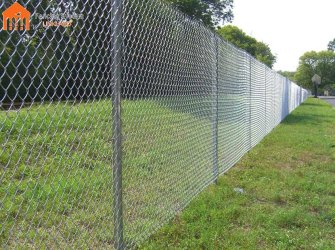
Chain link fence is one of the most widely used fencing systems for residential, commercial, agricultural, industrial, and infrastructure applications. It is typically made from woven chain link wire mesh supported by steel posts, tension wires, rails, fittings, and gates.
Unlike solid fences, chain link fencing provides a physical boundary without completely blocking visibility, airflow, or natural light. Its relatively simple structure also makes it easy to transport, install, repair, and expand.
From residential gardens and farms to factories, warehouses, sports facilities, and large infrastructure projects, chain link fence remains a practical fencing solution because it offers a good balance of security, durability, visibility, flexibility, and cost.
A chain link fence is a complete fencing system built around chain link wire mesh.
The mesh is produced by weaving steel wire into a continuous diamond-shaped pattern. It is then installed between supporting posts to create a perimeter barrier.
A typical chain link fence system may include:
The exact configuration depends on the height, application, security requirements, and installation environment.
This is an important distinction: chain link wire mesh is the fencing material, while chain link fence refers to the complete installed fencing system.
A chain link fence creates a continuous physical boundary around a property or designated area.
The posts provide structural support, while the woven mesh creates the actual barrier.
The basic installation structure is:
Foundation → Posts → Supporting Components → Chain Link Mesh → Gates
The posts are fixed into the ground, and the mesh is stretched between them. Tension wires, rails, and fittings help maintain the shape and stability of the fence.
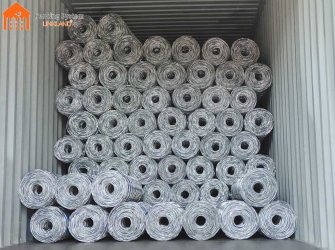
Because the mesh is supplied in rolls, it can cover long distances without requiring numerous inpidual fence panels.
The material of the wire mesh and supporting components affects the durability and service life of the fence.
Galvanized steel is one of the most common choices for chain link fencing.
The steel wire is coated with zinc to improve resistance against rust and corrosion.
It is widely used for:
PVC coated chain link fence combines a galvanized steel core with a protective PVC coating.
It provides:
Green PVC coated chain link fencing is particularly common for residential, recreational, and landscape applications.
Stainless steel chain link fencing is designed for environments where corrosion resistance is especially important.
It may be used in:
The popularity of chain link fencing comes from several practical advantages.
One of the biggest advantages of chain link fence is its relatively low overall cost.
The open mesh structure requires less material than many solid fencing systems, while roll-form construction can reduce transportation and installation costs.
This makes chain link fencing particularly attractive for projects involving long perimeter distances.
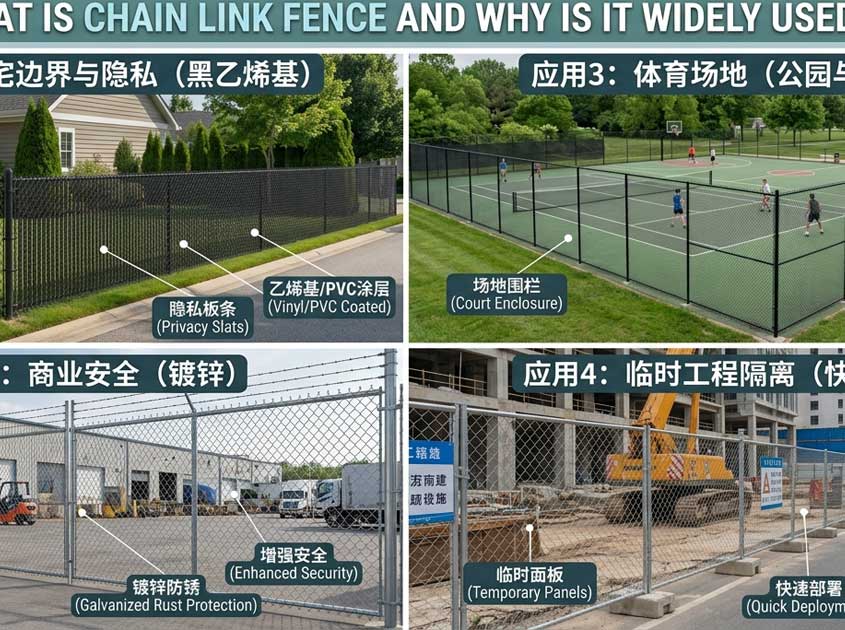
Typical applications include:
Chain link fence has a relatively simple installation process.
A typical project involves:
Because the mesh comes in rolls, it can be transported and installed efficiently across large areas.
Unlike solid metal panels, concrete walls, or privacy fencing, chain link mesh allows people to see through the fence.
This can be an important advantage for:
Security personnel can observe the protected area without removing the physical barrier.
The open diamond structure allows air to pass through the fence.
This reduces the wind load compared with many solid fencing systems.
As a result, chain link fence can be particularly useful in:
Chain link mesh is more flexible than rigid fence panels.
It can follow moderate changes in ground elevation, making it suitable for properties where the terrain is not perfectly flat.
This flexibility also makes chain link fencing convenient for:
If part of a chain link fence becomes damaged, it is often possible to replace only the affected section of mesh or inpidual components.
There is no need to replace the entire fence system.
This can help reduce:
Chain link fencing is suitable for a wide range of applications.
Chain link fence is commonly used for:
PVC coated mesh is often preferred where appearance is important.
Chain link fence can be used for:
Galvanized chain link mesh is commonly selected because of its durability and relatively low maintenance requirements.
Factories and warehouses often require large perimeter fencing areas.
Chain link fencing can provide an economical boundary around:
Chain link fence is widely used for temporary or semi-permanent construction site boundaries.
It can help:
The system can also be dismantled and reused when the project is completed.
Chain link fencing is frequently installed around:
Its visibility allows spectators to watch activities while the fence provides a physical boundary.
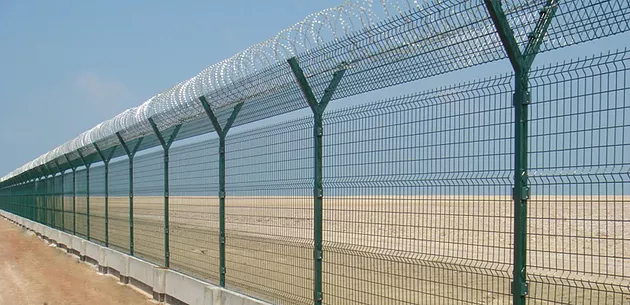
Although chain link fence is not inherently a high-security fence, its security performance can be increased by selecting appropriate specifications and accessories.
Security-focused systems may use:
For example, a facility may install a 2.4-3 meter high chain link fence with a small mesh opening and additional security wire above the fence.
The final configuration should be selected according to the required security level and local regulations.
There is no single standard specification suitable for every project.
The correct configuration depends on the application.
| Application | Typical Consideration |
|---|---|
| Garden fencing | Lower height, standard mesh |
| Residential fencing | 1.2-2.0 m height |
| Agricultural fencing | Larger mesh, galvanized wire |
| Industrial fencing | Thicker wire, stronger posts |
| Sports facilities | Higher fence with appropriate mesh |
| High-security areas | Smaller mesh, thicker wire, greater height |
These are general guidelines rather than fixed standards. Project specifications should always be confirmed before ordering.
Why do some projects choose chain link instead of solid fencing?
| Feature | Chain Link Fence | Solid Fence |
|---|---|---|
| Visibility | High | Low |
| Airflow | Excellent | Limited |
| Material usage | Relatively low | Higher |
| Installation | Generally simple | Varies |
| Privacy | Low | High |
| Large perimeter projects | Excellent | Can be more expensive |
| Wind exposure | Lower | Higher |
Chain link fence is particularly suitable when the objective is perimeter protection rather than privacy.
If privacy is the main requirement, a solid or privacy-oriented fencing system may be more appropriate.
Before purchasing a chain link fencing system, buyers should confirm several specifications.
Confirm:
Confirm:
Depending on the system, you may need:
Buying the complete system from one supplier can make specification matching and installation easier.
For B2B projects, selecting the manufacturer is as important as selecting the product.
Before placing an order, consider:
Can the manufacturer produce the required:
Ask about:
For international projects, an experienced exporter should understand:
linkland fence manufactures chain link wire mesh and fencing products for international customers.
We provide chain link fencing solutions for:
Customers can specify requirements such as:
By supplying both the mesh and related fencing components, we can help customers build complete chain link fencing systems according to project requirements.
Chain link fence is a fencing system made primarily from woven diamond-shaped wire mesh supported by posts, tension components, fittings, and gates.
Yes. Its strength depends on wire diameter, mesh opening, fence height, post structure, and installation method. Heavy-duty specifications can provide substantial perimeter protection.
Yes. Galvanized and PVC coated chain link fencing are widely used outdoors. The appropriate coating should be selected according to the local climate and corrosion conditions.
Chain link fencing is generally considered a cost-effective option, particularly for large perimeter projects. Total cost depends on mesh specifications, posts, accessories, installation, and transportation.
Yes, although the fence needs to be designed for the required security level. Thicker wire, smaller mesh openings, taller fencing, stronger posts, and additional security wire can improve protection.
Chain link mesh is the woven wire material, while chain link fence is the complete fencing system. A complete system may include mesh, posts, rails, tension wires, fittings, and gates.
Chain link fence remains widely used because it provides a practical combination of security, visibility, airflow, flexibility, easy installation, and cost efficiency.
It can be adapted to many applications, from residential gardens and agricultural properties to factories, warehouses, construction sites, sports facilities, and large infrastructure projects.
The key to getting the best performance is selecting the right combination of mesh opening, wire diameter, coating, fence height, posts, and accessories for the specific project.
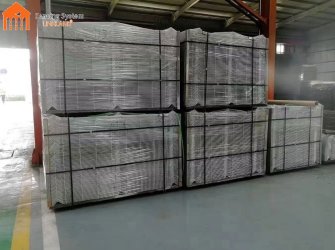
For contractors, distributors, and project buyers, working with an experienced manufacturer can also simplify specification matching, customization, packaging, and international supply.
Linkland fence provides chain link wire mesh and complete fencing components for customers worldwide, supporting projects that require reliable and customizable chain link fence solutions.
Pre:Why Do Farms Use Wire Mesh Fence Instead of Solid Walls?

 Address
Fast Delivery Promise

Join our mailing list for product update and news.




.png)
.png)
.png)
.png)
